
By Pedro Gellert
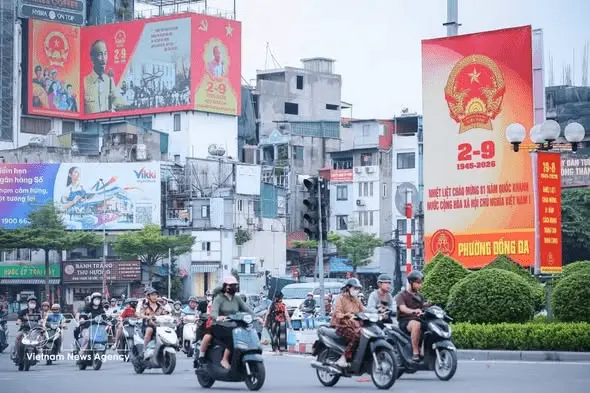
September 2 is Vietnam’s National Independence Day. On this date in 1945, the father of the Vietnamese nation and national hero, Ho Chi Minh, read the Declaration of Independence in Ba Dinh Square in Hanoi. The historic event marked the birth of the Democratic Republic of Vietnam and, for that reason, remains the country’s most important civic holiday, commemorating the beginning of its definitive struggle for national sovereignty.
That struggle first took the form of a revolutionary war against French colonial rule and later against U.S. military intervention. Vietnamese resistance inspired an entire generation of anti-imperialist fighters across five continents. Its final victory in May 1975 marked, at the time, a turning point in the global struggle for genuine national independence and sovereignty.
While the Vietnamese people’s victory remains in the collective memory of hundreds of millions of people around the world as a historic milestone, Vietnam today represents much more. Once again, the country is attracting international attention, this time for the impressive progress it has made in advancing its national development and socialist-oriented development model.
Forty years after the launch of the Renovation process (Doi Moi) (1986–2026), Vietnam has achieved economic and social gains of historic significance, laying the foundations for what its leaders describe as a new era of national development.
The economy has maintained a high growth rate, enabling the country to consolidate its position as an upper-middle-income developing economy. Average annual GDP growth during the 2016–2025 period was approximately 6.2 percent. Growth reached 7.09 percent in 2024 and accelerated to 8.02 percent in 2025.
The size of the economy and per capita income have nearly doubled, surpassing US$514 billion and US$5,026 per person, respectively. Sustained progress across key economic and social indicators has translated into significant improvements in living standards.
Important advances have also been made in the economic, cultural, and social spheres. The poverty rate, which exceeded 70 percent in the mid-1980s, fell to less than 1 percent in 2025 according to the United Nations’ multidimensional poverty standard. Meanwhile, Vietnam’s Human Development Index (HDI) rose from 0.499 in 1990 to 0.766 in 2023, representing a 53.5 percent increase.
Literacy programs have been highly effective, bringing the adult literacy rate to nearly 99 percent. Health insurance coverage reached 94.1 percent of the population in 2024, while more than 96 percent of households have access to clean water, sanitation, and electricity.
Vietnam has also emerged as one of the world’s most open and economically integrated countries. It currently has 17 free trade agreements in force covering 60 strategic partners. In 2025, the country’s foreign trade reached US$930 billion, while foreign direct investment exceeded US$38 billion.
The country has further consolidated its position as an emerging manufacturing hub in Asia, particularly in electronics, technology products, and other strategic industries. Between 1986 and 2024, the Vietnamese economy expanded 96-fold, placing it 32nd in the world. At the same time, sustained investment in highways, airports, seaports, and the national power grid has transformed the country’s infrastructure and reshaped its economic landscape.
In 2025, Vietnam undertook a historic administrative reform designed to make more effective use of national resources, promote sustainable development at the grassroots level, and place citizens at the center of public policy. The reform streamlined the governmental structure from four levels to three—central, provincial, and communal—by eliminating the district level. It also rationalized provincial-level administrative units, reducing the number of provinces and centrally administered cities from 63 to 34.
Today, Vietnam ranks among the countries with the highest levels of security and social stability. Its defense policy remains firmly grounded in the principles known as the “Four No’s”: no participation in military alliances; no alignment with one country against another; no allowing foreign military bases on Vietnamese territory or permitting its territory to be used against third countries; and no use or threat of use of force in international relations.
This policy helps safeguard Vietnam’s independence, sovereignty, unity, and territorial integrity while contributing to political stability, social order, and a peaceful environment conducive to national development.
Against the backdrop of major changes in the international and regional environment, and in response to the demands arising from the country’s revolutionary experience, the Communist Party of Vietnam successfully convened its 14th National Congress. The congress adopted a resolution establishing the country’s broad development objectives for 2026–2030, with a longer-term vision extending to 2045.
In the area of foreign policy, the resolution reaffirms Vietnam’s determination to “consistently pursue a foreign policy of independence, self-determination, self-reliance, peace, friendship, cooperation, and development; promote the multilateralization and diversification of external relations; and make Vietnam a friend, a reliable partner, and an active, responsible member of the international community.”
Vietnam’s experience over the past several decades, together with its forward-looking development strategy, underscores the continued importance of a vision centered on a humane, solidarity-oriented, and prosperous society built on socialist foundations. In this regard, Vietnam’s experience forms part of the broader history of successful struggles for the emancipation and advancement of peoples around the world.
For this reason, Vietnam’s achievements and experience today hold significance not only for its own people but also for the broader international effort to build a more just, peaceful, prosperous and better world.